Exploring LoRA: Efficient Fine-Tuning for Large Language Models
Summary:
A deep dive into LoRA (Low-Rank Adaptation) and how it enables efficient, task-specific fine-tuning of large language models without massive compute or storage costs.
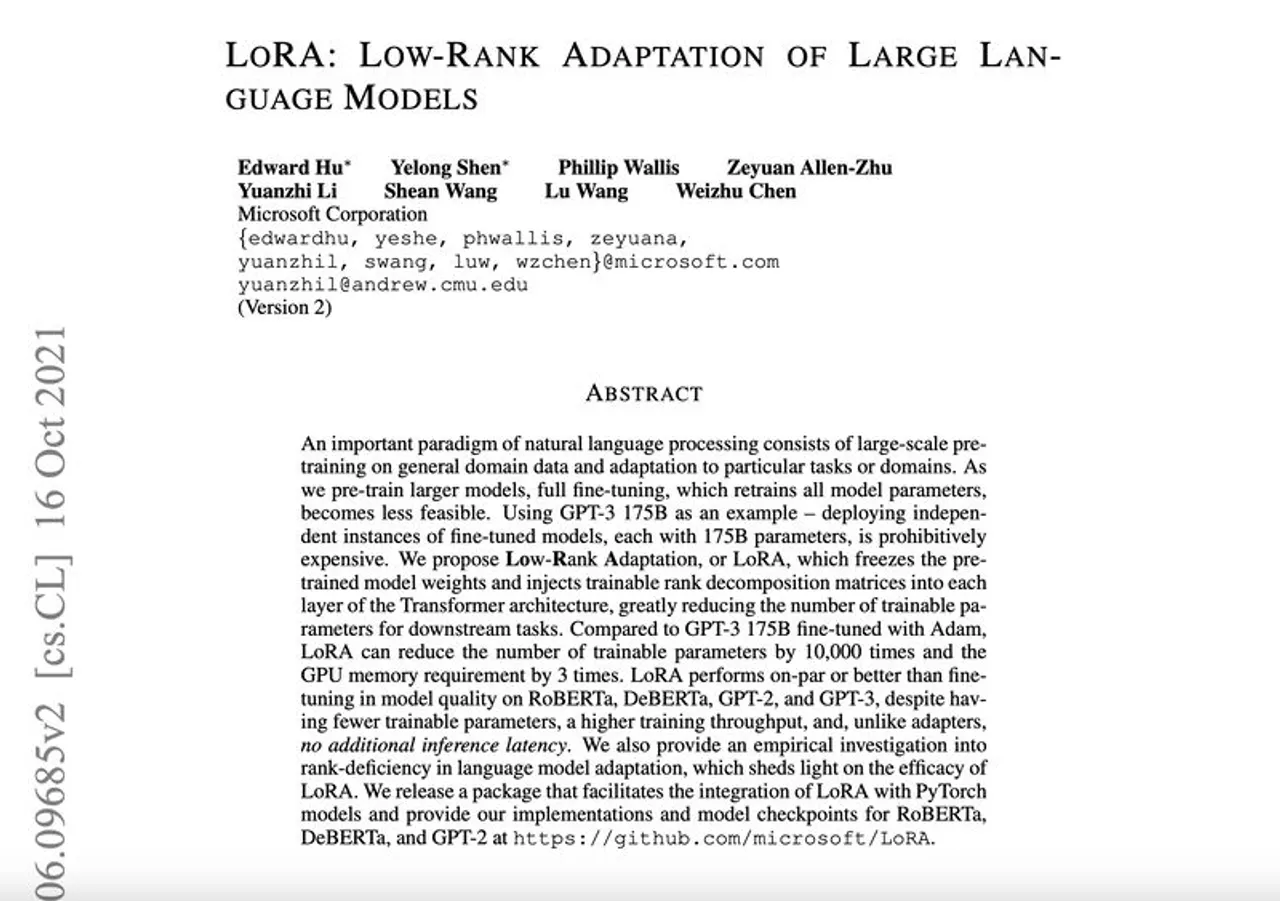
Recently, I finished reading the research paper LoRA: Low-Rank Adaptation of Large Language Models to learn how to refine and tune generative pre-trained transformers.
LoRA is a method that enables lightweight fine-tuning of large language models via low-rank adapters.
Here are the coolest insights I gained from the paper:
- Lightweight Adapters: LoRA allows us to train lightweight adapters for large language models. For example, with GPT-3 (350GB), training 100 different LoRA adapters increases storage only to 354GB instead of 35TB.
- Low Intrinsic Dimension: Pre-trained language models have a low intrinsic dimension, meaning they can learn efficiently even when projected into a much smaller subspace.
- Efficient Fine-Tuning: LoRA freezes the original model weights and updates only the low-rank matrices, making fine-tuning cheaper, faster, and more memory-efficient.
- Task Specialization: This approach enables task-specific adaptation without duplicating massive models, allowing quick swapping between adapters.
- Strong Performance: On benchmarks like GLUE, WikiSQL, and SAMSum, LoRA performs comparably to full fine-tuning while drastically reducing compute and storage requirements.
I’m excited to experiment with these ideas in the future — from creating smaller, task-specific adapters to exploring how efficient fine-tuning techniques like LoRA can make cutting-edge AI models more practical, scalable, and accessible.
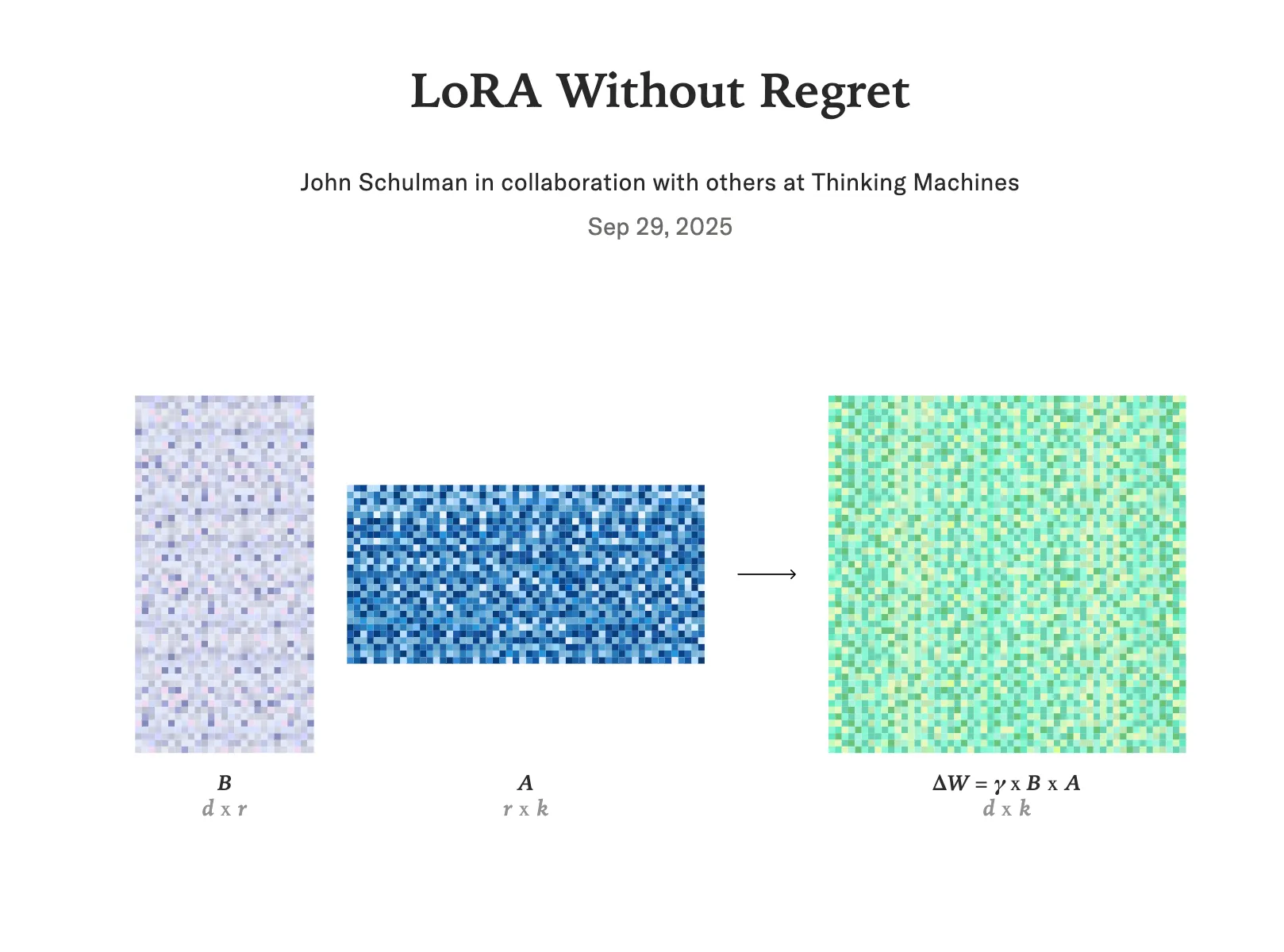
Next, I’m starting to read a recent paper published by Thinking Machines Lab titled “LoRA Without Regret” (Thinking Machines Lab, 2025) to learn how to tune hyperparameters when refining large language models with LoRA.
探索 LoRA:面向大语言模型的高效微调
总结:
这篇文章是我对 LoRA,也就是 Low-Rank Adaptation 的一次深入学习记录。
LoRA 让大语言模型可以用更低的算力和存储成本完成高效的任务微调。
最近,我读完了论文 LoRA: Low-Rank Adaptation of Large Language Models。
我想借此学习如何优化和调整 generative pre-trained transformers。
LoRA 是一种通过 low-rank adapters 对大语言模型进行轻量微调的方法。
下面是我从论文中学到的几个最有意思的观点:
- 轻量级 adapters: LoRA 允许我们为大语言模型训练轻量级 adapters。 以 GPT-3 为例,原模型约为 350GB。 如果训练 100 个不同的 LoRA adapters,总存储只会增加到约 354GB,而不是 35TB。
- 低内在维度: 预训练语言模型具有 low intrinsic dimension。 这意味着即使被投影到更小的子空间中,它们也能高效学习。
- 高效微调: LoRA 会冻结原始模型权重,只更新 low-rank matrices。 这种方式让微调更便宜、更快,也更节省内存。
- 任务专门化: 这种方法支持 task-specific adaptation,而不需要复制庞大的模型。 它也让不同 adapters 之间的快速切换成为可能。
- 强表现: 在 GLUE、WikiSQL 和 SAMSum 等 benchmark 上,LoRA 的表现接近 full fine-tuning,同时显著降低计算和存储成本。
我很期待未来继续实验这些想法。
从创建更小的 task-specific adapters,到探索如何让高效微调技术帮助前沿 AI 模型变得更实用、更可扩展,也更容易被更多人使用。
接下来,我准备阅读 Thinking Machines Lab 最近发布的一篇文章 “LoRA Without Regret”,继续学习在微调大语言模型时如何调整 hyperparameters。